 BACK TO ARTICLES
Longevity as a Business Strategy: Investment, Not Cost
In an economy facing a labor shortage and accelerated aging, companies that treat longevity as a “tactical” HR issue risk losing a real competitive advantage. The conversation is clearly shifting from “how do we cope with aging?” to “how do we turn longevity into strategy?” — through retention, professional reconversion, and demographic planning, with the direct involvement of management and boards.
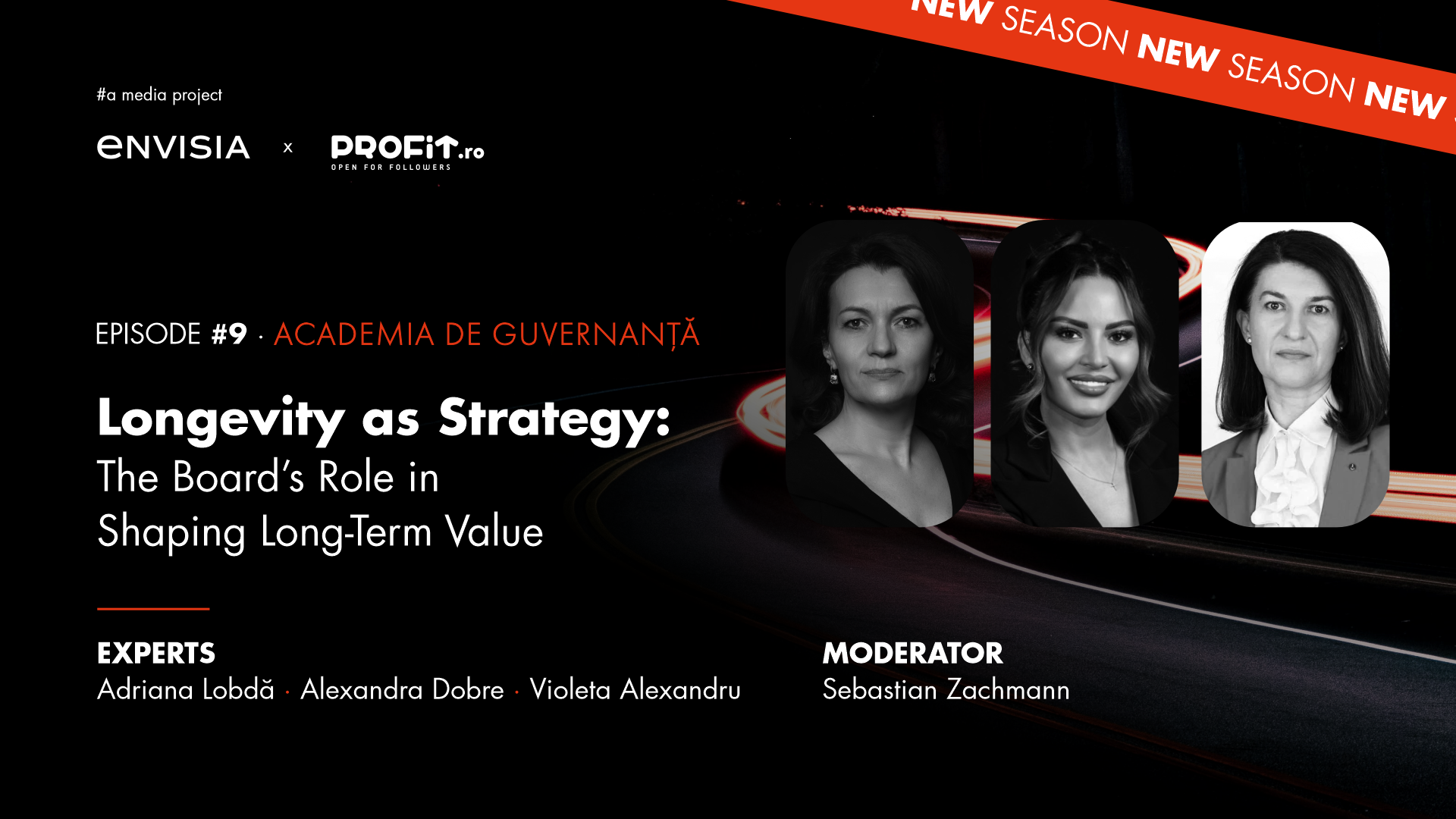
This topic was addressed during the 9th edition of the Academia de Guvernanță (Envisia, Profit.ro, Prima News), in a discussion moderated by Sebastian Zachmann, with contributions from Adriana Lobdă (Envisia), Violeta Alexandru (senator, former Minister of Labor), and Alexandra Dobre (Association for Active Aging Institute).
Longevity – From Demographic Burden to Business Strategy
Against the backdrop of demographic shifts and an increasingly acute labor shortage, the conversation about the role of older adults in companies is taking on a new dimension — that of strategic opportunity. During the 9th edition of the Academia de Guvernanță (organized by Envisia and Profit.ro), experts, leaders, and civil society representatives explained why “longevity” — meaning the presence and involvement of senior employees — should be seen as an important investment, not a cost.

Demographics Are Knocking at the Door of Business
As the average age of the population increases, the labor market is feeling the pressure: there are fewer and fewer young people, specialists are harder to find, and companies face a dilemma — how to ensure continuity without losing experience? According to the organizers and speakers of Academia de Guvernanță, the solution is not only recruitment but leveraging the potential that already exists: senior employees — with know-how, stability, and expertise.
“The future of work isn’t only about artificial intelligence and automation — it’s also about demographics,” the speakers emphasized, calling for a re-evaluation of how companies think about their workforce.

Time Is Capital — Not Risk
A departing senior employee has often been viewed as a cost: retirement, pensions, restructuring. But the participants in the debate argue it should be seen as a strategic investment. In their view:
Replacing a senior employee involves high costs (recruitment, training, loss of productivity, loss of know-how).
Retaining and retraining senior staff can reduce those costs and — more importantly — build stability, consistency, and continuity within the team.
Thus, longevity becomes an asset — not a liability.

From Stereotypes to Competitive Advantage
This paradigm shift requires courage: it’s not enough to merely “accept” senior employees — companies must rethink roles, hierarchies, and HR processes. This includes:
conducting an internal demographic audit: how many employees are 50+, what skills they have, and how critical those skills are;
developing retention and retraining strategies — not as charity, but as a business decision;
involving boards and leadership: workforce-related decisions are no longer just an HR matter, but a strategic one.
In this way, age becomes an advantage — of experience, continuity, and stability — not a reason for exclusion.
What Companies Can Do Today
The experts from Academia de Guvernanță suggest a set of concrete actions companies can implement immediately:
analyze the age structure of their workforce and identify critical competencies;
create programs for retraining, internal mobility, and mentorship — so that senior employees remain active, useful, and motivated;
involve boards in demographic planning — not just asking “do we need more people,” but rather “who is staying, and with what skills” in the medium to long term.
Conclusion
What has often been perceived as a social burden is now becoming a strategic potential: longevity is no longer tomorrow’s problem — it’s a valuable resource for today and the future. For companies, for the economy, and for society. This paradigm shift — from stereotype to strategy — can make the difference between an organization with fragile foundations and one with solid ground, capable of weathering demographic crises, attracting investment, and remaining competitive.
Because, in the end, experience, stability, and commitment have no age — and might just be the most powerful strategic advantage.
About the Project
Academia de Guvernanță is a media project created by Prima News, Profit.ro, and Envisia, the first business school in Romania dedicated to corporate governance and the professional development of board members.
📺 Watch every Friday at 20:00 on Prima News. Re-run on Tuesday at 23:00. Online at Profit.ro
About Envisia
Envisia is Romania’s first business school focused on corporate governance and the professionalization of board members. Through accredited programs, masterclasses, and media initiatives such as Academia de Guvernanță, Envisia helps shape leaders who turn the principles of good governance into performance and trust.
More details at www.envisia.eu
 Facebook
 Linkedin
Recommended articles
ESG & Risk Oversight
ESG & Risk Oversight
Governance & Board Effectiveness
Governance & Board Effectiveness
Governance & Board Effectiveness
Governance & Board Effectiveness
Digital Transformation & AI Governance
Governance & Board Effectiveness
Governance & Board Effectiveness
Governance & Board Effectiveness
Governance & Board Effectiveness
Digital Transformation & AI Governance
Digital Transformation & AI Governance
Governance & Board Effectiveness
Leadership, Boardroom Dynamics & Crisis Response
Future of Boards & NED Careers
Leadership, Boardroom Dynamics & Crisis Response
Governance & Board Effectiveness
Leadership, Boardroom Dynamics & Crisis Response
Digital Transformation & AI Governance
ESG & Risk Oversight
Governance & Board Effectiveness
Leadership, Boardroom Dynamics & Crisis Response
Digital Transformation & AI Governance
Leadership, Boardroom Dynamics & Crisis Response
Leadership, Boardroom Dynamics & Crisis Response
Governance & Board Effectiveness
Future of Boards & NED Careers
Future of Boards & NED Careers
ESG & Risk Oversight
Leadership, Boardroom Dynamics & Crisis Response
Governance & Board Effectiveness
Governance & Board Effectiveness
Leadership, Boardroom Dynamics & Crisis Response
Future of Boards & NED Careers
Governance & Board Effectiveness
Governance & Board Effectiveness
Governance & Board Effectiveness
Governance & Board Effectiveness
Future of Boards & NED Careers
Leadership, Boardroom Dynamics & Crisis Response
Future of Boards & NED Careers

