 BACK TO ARTICLES
A Strategic Guide for Boards: Integrating Energy Efficiency, Smart Buildings, and Corporate Governance
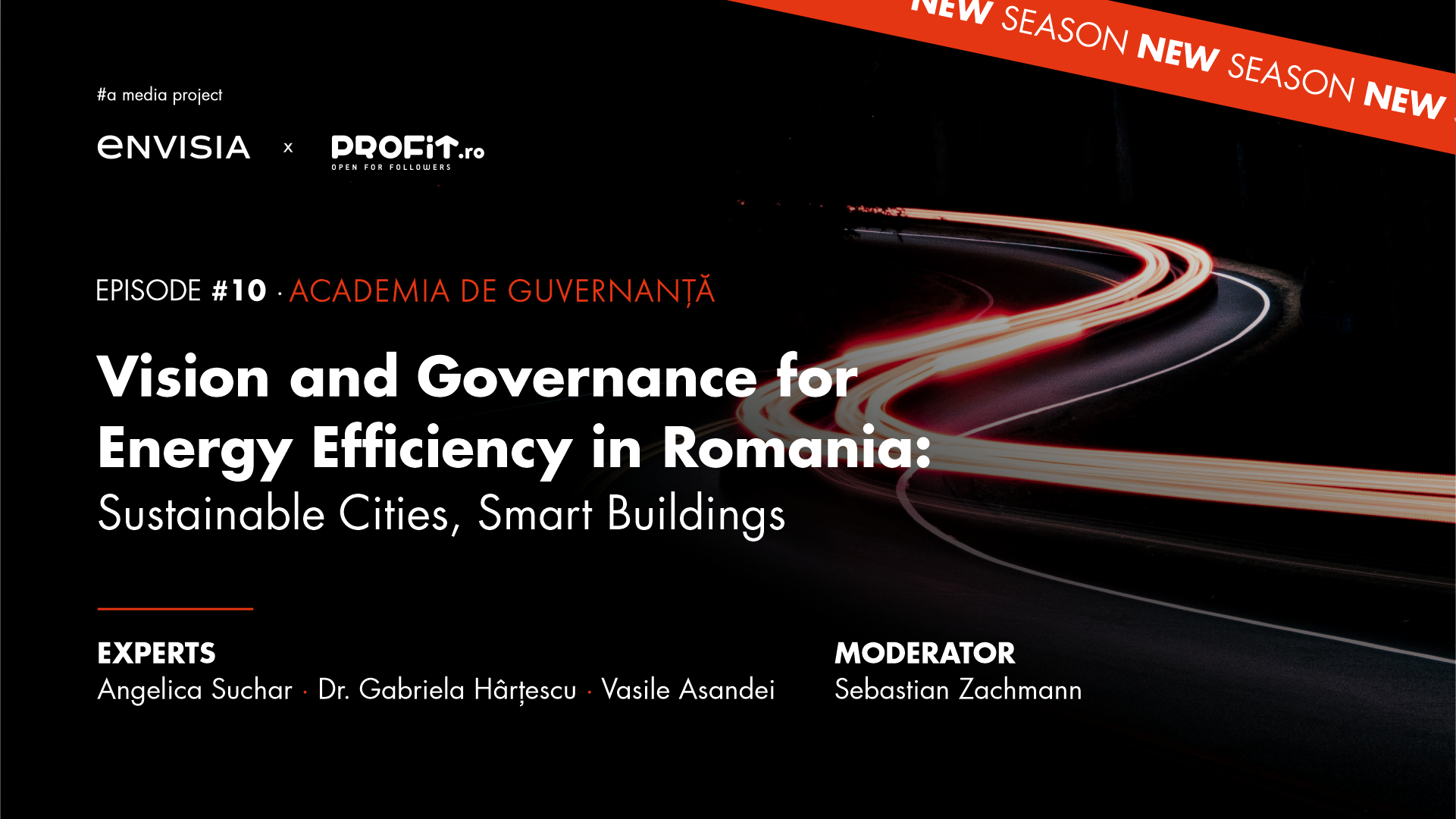
The lack of a coherent legislative framework, insufficient technical skills, fragmented financing, and pressure from long-term investments are the main obstacles to the development of nearly zero-energy buildings, experts say. At the same time, predictive modeling, machine learning, and integrated thinking are key elements that can transform Smart Building Management Systems into a catalyst for energy efficiency at urban and regional levels.
This was the topic of Episode #10 of the Academia de Guvernanță, a media project developed by Envisia, Profit.ro, and Prima News. The episode brought together Dr. Gabriela Hârțescu, Dean and Founding Member of Envisia; Angelica Suchar, Development Manager at Quartz Matrix; and Vasile Asandei, President of ROREG and General Director of the North-East Regional Development Agency. The discussion focused on the transition toward smart cities and smart buildings. Moderator: Sebastian Zachmann.
The Road to Zero-Emission Buildings: What Boards Need to Know
Gabriela Hârțescu, Dean and Founding Member of Envisia, emphasizes that Romania is at a critical moment when it comes to implementing intelligent building management systems and achieving nearly zero-energy building (nZEB) standards. While technology and financing are not necessarily barriers, the real challenges lie in regulation, lack of skills, and institutional resistance.
“The transition to smart building management systems and nearly zero-energy systems for buildings is a major objective for Romania and for Europe. I believe the difficulty does not necessarily lie in the lack of funds or in technology failing to meet the requirements for implementing these concepts, but rather in several blockages that we also see in other areas,” stated Gabriela.

She further explains the legislative dimension, where inconsistencies between energy, urban planning, and public procurement regulations can block local authority decision-making. At the same time, investors become hesitant when they foresee regulatory risks related to long-term return on investment.
The Technology Solution: What are Smart Buildings and Intelligent Management Systems (BMS)?
Angelica Suchar, Development Manager at Quartz Matrix, explains that the true innovation of modern BMS solutions lies in transforming data into predictive operational decisions.
“The main innovative aspect of this product is that it performs predictive modeling. In general, classic Smart BMS systems stop at the control stage. What we do differently is that we collect data from all these systems and turn it into a decision-making factor,” said Angelica Suchar.
The Innovative Edge: Machine Learning in Energy Optimization
The Quartz Matrix representative continues by explaining that integrating machine learning algorithms enables the creation of a digital model of the building, contributing to precise, measurable, and real-time optimized energy management.

Angelica highlights that the new prototype, developed with funding from the North-East Regional Development Agency (ADR Nord-Est), covers all building systems: HVAC, lighting, security, access, utilities, and maintenance. As a result, Smart BMS becomes a comprehensive tool for energy efficiency and traceability, useful even for ISO certifications.
“Ultimately, both energy management and the Smart BMS system must lead me to real energy efficiency, which I can validate through real-time measured data,” she added.
Energy Management as a Governance Imperative: The Role of the Board
Another major obstacle is the lack of specialized skills. Gabriela points out that public managers, data specialists, Internet of Things (IoT) experts, and technical staff must be trained to attract funding and manage complex, integrated, and modern digital systems.
“Here we see the need for professionalization even among public managers… we are talking about specialists in data and Internet of Things who need to know how to capitalize on and coordinate such information,” she said.
She also highlights cultural resistance and the institutional focus on projects with immediate visibility—such as road paving—rather than long-term strategic investments like modernizing district heating networks.
ROREG President and General Director of ADR Nord-Est, Vasile Asandei, defines short-term objectives as the rapid conversion of available funding into concrete projects: technical documentation, applications, and implementation. With a contribution of only 2%, the benefits are significant. Long-term objectives, however, involve integrating all resources into a National Partnership Plan, which will replace the current 16 operational programs.
“We need to bring specialists, decision-makers, needs, opportunities, and resources to the same table and decide where we want to go,” Asandei concluded.
How Energy Efficiency Fulfills Your ESG Requirements
The discussion around systems thinking brings together specialists, authorities, designers, engineers, and technicians. Angelica explains that only an interdisciplinary approach can lead to nZEB buildings and smart cities.
“Thinking about a nearly zero-energy building means putting multiple specialties at the same table… it’s like a puzzle,” said Angelica Suchar.
From Gabriela Hârțescu’s perspective, this transition is “not only not a utopia,” but a necessity imposed by the European framework and the upcoming energy taxonomy.
“…if we talk about smart buildings and smart cities, then we are also talking about a smart Europe,” she emphasized.
She stresses the role of responsible governance and well-prepared boards of directors that prioritize strategic objectives over immediate ones.
Gabriela Hârțescu believes Romania has competent leaders, but many have been trained directly on projects, learning along the way. Envisia aims to support the development of hybrid leaders with both technical and strategic expertise.
“Leaders must combine technical knowledge with strategic and visionary skills… some are trained on the job, while others can access multidisciplinary hybrid leadership programs,” Gabriela explained.
The Bigger Picture: From Smart Buildings to Sustainable Smart City Ecosystems
Quartz Matrix is developing two distinct prototypes: one for office buildings and one for industrial buildings. For office buildings, the focus is on occupant comfort and reducing waste caused by human variability.
“I can be at the office and start work at nine, and the system knows how to optimize itself… the system can detect when certain spaces are unoccupied and optimize consumption,” explained Angelica Suchar.
In industrial environments, however, the focus shifts to equipment, processes, and predictive maintenance to prevent major losses.
“If a motor or a fan breaks down during my production process, it can cause very large losses,” she noted.
From Vasile Asandei’s point of view, Romania’s problem is not a lack of funding, but rather its fragmentation.
“There are multiple financing mechanisms, and perhaps the issue lies precisely in this ‘multiple’… different programs, different calendars, different institutions, different rules,” said the President of ROREG and General Director of ADR Nord-Est.

For public buildings, things are relatively straightforward. The major challenge lies with residential buildings, where beneficiaries have often been blocked by procedures, seismic risks, unclear rules, and the legacy of privately executed, non-compliant construction works.
Asandei explains that current programs include restrictions related to seismic risk, while funding available for consolidation is limited. As a result, many projects are not eligible and beneficiaries become discouraged.
“People were no longer willing to contribute additional financial resources… and an important resource allocated to housing complexes was only utilized to a very small extent,” he added.
Key Conclusions
- Romania needs a coherent legislative framework and specialized financial and technical skills for the real implementation of smart buildings.
- Predictive modeling and machine learning are key elements that move Smart BMS beyond control toward decision-making and optimization.
- Fragmented financing and unclear requirements have blocked residential energy efficiency projects for years.
- Reducing beneficiary contributions to 2% and eliminating unanimity requirements could relaunch energy renovation programs.
- Long-term success depends on integrated thinking and leaders capable of combining technology with strategy.
Academia de Guvernanță
Academia de Guvernanță is a media project produced by Prima News, Profit.ro, and Envisia—the first business school in Romania dedicated to corporate governance and the professionalization of board members. Broadcast every Friday at 8:00 PM on Prima News. Replay on Tuesdays at 11:00 PM. Available online on Profit.ro.
About Envisia
Envisia is the first business school in Romania dedicated to corporate governance and the professionalization of board members. Through accredited programs, masterclasses, and media projects such as Academia de Guvernanță, Envisia contributes to developing leaders who transform good governance principles into performance and trust. More details at www.envisia.eu
 Facebook
 Linkedin
Recommended articles
ESG & Risk Oversight
ESG & Risk Oversight
Governance & Board Effectiveness
Governance & Board Effectiveness
Governance & Board Effectiveness
Governance & Board Effectiveness
Digital Transformation & AI Governance
Governance & Board Effectiveness
Governance & Board Effectiveness
Governance & Board Effectiveness
Governance & Board Effectiveness
Digital Transformation & AI Governance
Digital Transformation & AI Governance
Governance & Board Effectiveness
Leadership, Boardroom Dynamics & Crisis Response
Future of Boards & NED Careers
Leadership, Boardroom Dynamics & Crisis Response
Governance & Board Effectiveness
Leadership, Boardroom Dynamics & Crisis Response
Digital Transformation & AI Governance
ESG & Risk Oversight
Governance & Board Effectiveness
Leadership, Boardroom Dynamics & Crisis Response
Digital Transformation & AI Governance
Leadership, Boardroom Dynamics & Crisis Response
Leadership, Boardroom Dynamics & Crisis Response
Governance & Board Effectiveness
Future of Boards & NED Careers
Future of Boards & NED Careers
ESG & Risk Oversight
Leadership, Boardroom Dynamics & Crisis Response
Governance & Board Effectiveness
Governance & Board Effectiveness
Leadership, Boardroom Dynamics & Crisis Response
Future of Boards & NED Careers
Governance & Board Effectiveness
Governance & Board Effectiveness
Governance & Board Effectiveness
Governance & Board Effectiveness
Future of Boards & NED Careers
Leadership, Boardroom Dynamics & Crisis Response
Future of Boards & NED Careers

