 BACK TO ARTICLES
The End of “Normal”: Why Boards Must Lead Through the Geopolitical Supercycle
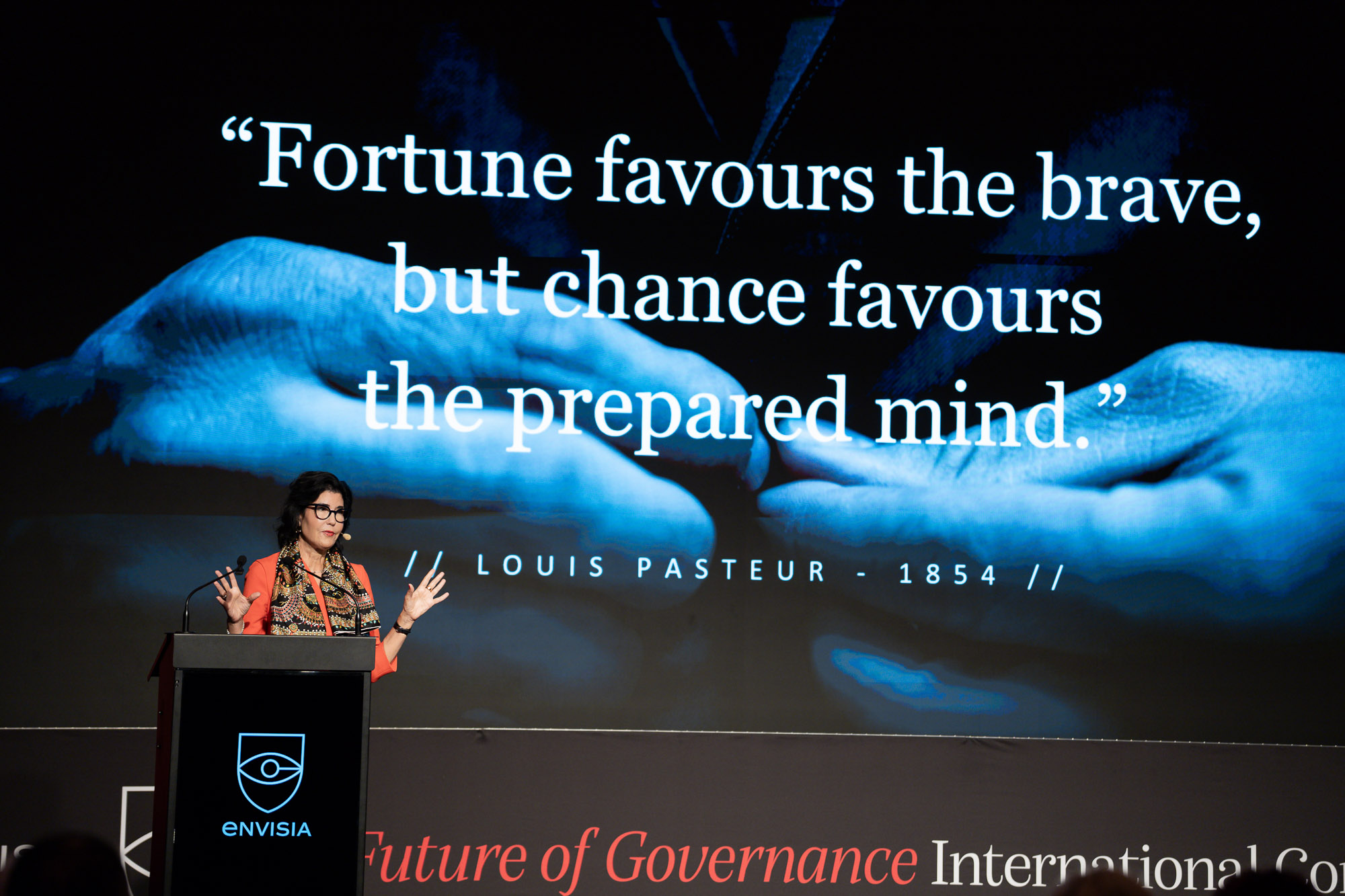
At the 5th edition of the Future of Governance International Conference 2026, one idea returned repeatedly throughout the day: leadership today is no longer exercised in moments of episodic crisis, but under conditions of permanent structural tension.
It was perhaps Tina Fordham who articulated this reality most clearly.
Invited to open the conference — held this year under the theme The Great Governance Reset — Fordham delivered a sharp and deeply unsettling analysis of the geopolitical environment leaders now have to navigate. Drawing on decades spent advising governments, boards, financial institutions and international organisations, she argued that what many executives continue to interpret as “volatility” is, in fact, a fundamental rewiring of the global operating system.
The instability we are experiencing is not temporary. It is structural. And perhaps most importantly, it is unlikely to reverse. One of the most revealing moments of her intervention came when she described the question she still hears most often inside boardrooms: “When are things going back to normal?”
The illusion of “normal” and modern corporate governance issues
For Fordham, the question itself reveals how deeply many organisations remain anchored in assumptions built for a world that no longer exists. The “normal” leaders are hoping to return to is often a memory of the post-Cold War era — a period defined by expanding globalisation, institutional predictability, relatively stable alliances and the belief that economic integration naturally produces political stability.
But over the past two decades, that logic has progressively fractured. The global financial crisis, the pandemic, the full-scale invasion of Ukraine, the weaponisation of energy and trade, growing technological dependencies, the erosion of institutional trust and the rise of geopolitical competition have fundamentally altered the conditions under which leadership operates.
Waiting for stability to return is no longer a strategy.
In Fordham’s view, boards now need to accept something much harder: volatility is not interrupting the system. Volatility is the system.
The geopolitical supercycle: A new era for board strategy
A central idea in her presentation was what she calls the “Geopolitical Supercycle” — a long-term structural shift marked by rising geopolitical risk, weakening institutional guardrails and increasingly aggressive competition between states. Her research tracking developments between 2010 and 2024 identified a tripling of geopolitical risk events, a doubling of conflicts and a tenfold increase in trade disputes.
This matters because it changes the role of leadership itself.
For years, geopolitics was treated by many business leaders as background context — something discussed by governments, diplomats or emerging markets investors, but largely external to core corporate strategy. Fordham challenged that assumption directly. Geopolitics, she argued, is not simply the news cycle or the ability to discuss headlines at a board meeting. It is the projection of power beyond borders: the way countries attempt to secure influence, reshape markets, exploit dependencies and alter the rules of the game to their advantage.
Under these conditions, geopolitics becomes embedded in everything from supply chains and cloud infrastructure to energy security, AI capabilities, regulation, industrial policy and capital allocation. The implications for boards are enormous.
From board optimisation to business resilience
Many organisations were built during the peak-globalisation era, when the dominant logic was optimisation. Efficiency became the ultimate strategic virtue: lean operations, just-in-time supply chains, cost reduction and global sourcing were considered signs of managerial excellence. Fordham referenced a remark by Jamie Dimon that captured this mentality with brutal simplicity: companies moved production across the world “to save 10 dollars on a cable.” That era is ending.
Increasingly, organisations are being forced to prioritise resilience over optimisation. Supply chains are becoming shorter, more regional and more redundant. Governments are pursuing technological sovereignty. Companies are reassessing strategic dependencies that, until recently, seemed economically rational but are now viewed as vulnerabilities.
This shift comes with costs. Resilience is more expensive than efficiency. Redundancy lowers margins. Strategic autonomy often reduces short-term profitability. But survivability, Fordham suggested, is becoming one of the defining competitive advantages of the coming decade.
Europe’s strategic moment for organizational resilience
Europe sits in a particularly complex position within this transition. Caught between an increasingly transactional United States, an openly adversarial Russia and an economically assertive China, European leaders are being forced to rethink long-standing assumptions about alliances, security and dependency. Much of the language now emerging from European institutions around “sovereignty” and “autonomy” reflects precisely this repositioning.
Digital sovereignty, independent infrastructure, regional supply resilience and strategic industrial capacity are no longer abstract policy conversations. They are rapidly becoming economic doctrine. And yet, despite the turbulence, Fordham also pointed toward a potential opportunity for Europe. In a world increasingly defined by fragmentation and distrust, stability itself becomes strategic value.
Institutional reliability, governance maturity and regulatory predictability may prove to be major competitive advantages in the years ahead — particularly for countries capable of positioning themselves as trusted operational ecosystems within a more fractured global economy.
This is one reason why the conversation resonated so strongly with the audience gathered in Bucharest at Future of Governance. Much of the conference explored precisely this tension between governance as a compliance exercise and governance as a strategic capability required to navigate systemic instability.
Board leadership now requires political intelligence (PQ)
Fordham’s intervention pushed that conversation further. Leadership today, she argued, is no longer about mastering certainty. It is about developing the ability to operate intelligently under conditions of ambiguity, complexity and permanent pressure. That requires a different type of executive mindset.
One of the concepts she returned to repeatedly was the idea of “Political Quotient” — or PQ. Not partisan politics, but the capacity to understand how public sentiment, geopolitical shifts, institutional legitimacy and state behaviour increasingly shape business outcomes. Leaders who fail to develop this capability risk misreading the environment entirely.
Perhaps the most striking section of her talk came when she described the “plausible hypothetical” exercises she runs with boards and executive teams. Participants are asked to consider scenarios that initially sound unrealistic or exaggerated — regime collapse, territorial annexation, strategic fragmentation, political rupture. Yet repeatedly, events dismissed as implausible become reality within months. The lesson is not about prediction. It is about intellectual flexibility.
Many organisations still operate with an implicit assumption of continuity. But periods of structural rupture dramatically widen the range of plausible outcomes leaders must be prepared to navigate. Strategic imagination, cognitive adaptability and the ability to challenge inherited assumptions are rapidly becoming governance necessities rather than leadership luxuries.
Strategic leadership after the rupture: Resilience in business
Near the end of her keynote, Fordham referenced a word used earlier this year by Mark Carney at Davos: rupture. Not adjustment. Not recalibration. Rupture. The distinction matters. Because if this truly is a rupture, then leadership cannot be built around nostalgia for a previous system. It must be built around the capacity to navigate the one that is emerging.
Fordham closed with a quote from Louis Pasteur: “Be brave and be open-minded.” At Future of Governance 2026, it did not sound like a philosophical reflection. It sounded like a board-level imperative.
.png)
 Facebook
 Linkedin
Recommended articles
Governance & Board Effectiveness
ESG & Risk Oversight
ESG & Risk Oversight
Governance & Board Effectiveness
Governance & Board Effectiveness
Governance & Board Effectiveness
Governance & Board Effectiveness
Digital Transformation & AI Governance
Governance & Board Effectiveness
Governance & Board Effectiveness
Governance & Board Effectiveness
Governance & Board Effectiveness
Digital Transformation & AI Governance
Digital Transformation & AI Governance
Governance & Board Effectiveness
Leadership, Boardroom Dynamics & Crisis Response
Future of Boards & NED Careers
Leadership, Boardroom Dynamics & Crisis Response
Governance & Board Effectiveness
Leadership, Boardroom Dynamics & Crisis Response
Digital Transformation & AI Governance
ESG & Risk Oversight
Governance & Board Effectiveness
Leadership, Boardroom Dynamics & Crisis Response
Digital Transformation & AI Governance
Leadership, Boardroom Dynamics & Crisis Response
Leadership, Boardroom Dynamics & Crisis Response
Governance & Board Effectiveness
Future of Boards & NED Careers
Future of Boards & NED Careers
ESG & Risk Oversight
Leadership, Boardroom Dynamics & Crisis Response
Governance & Board Effectiveness
Governance & Board Effectiveness
Leadership, Boardroom Dynamics & Crisis Response
Future of Boards & NED Careers
Governance & Board Effectiveness
Governance & Board Effectiveness
Governance & Board Effectiveness
Governance & Board Effectiveness
Future of Boards & NED Careers
Leadership, Boardroom Dynamics & Crisis Response
Future of Boards & NED Careers

