 BACK TO ARTICLES
Beyond Compliance: Why the New Pan-European CGFM Certification is a Corporate Governance Game-Changer
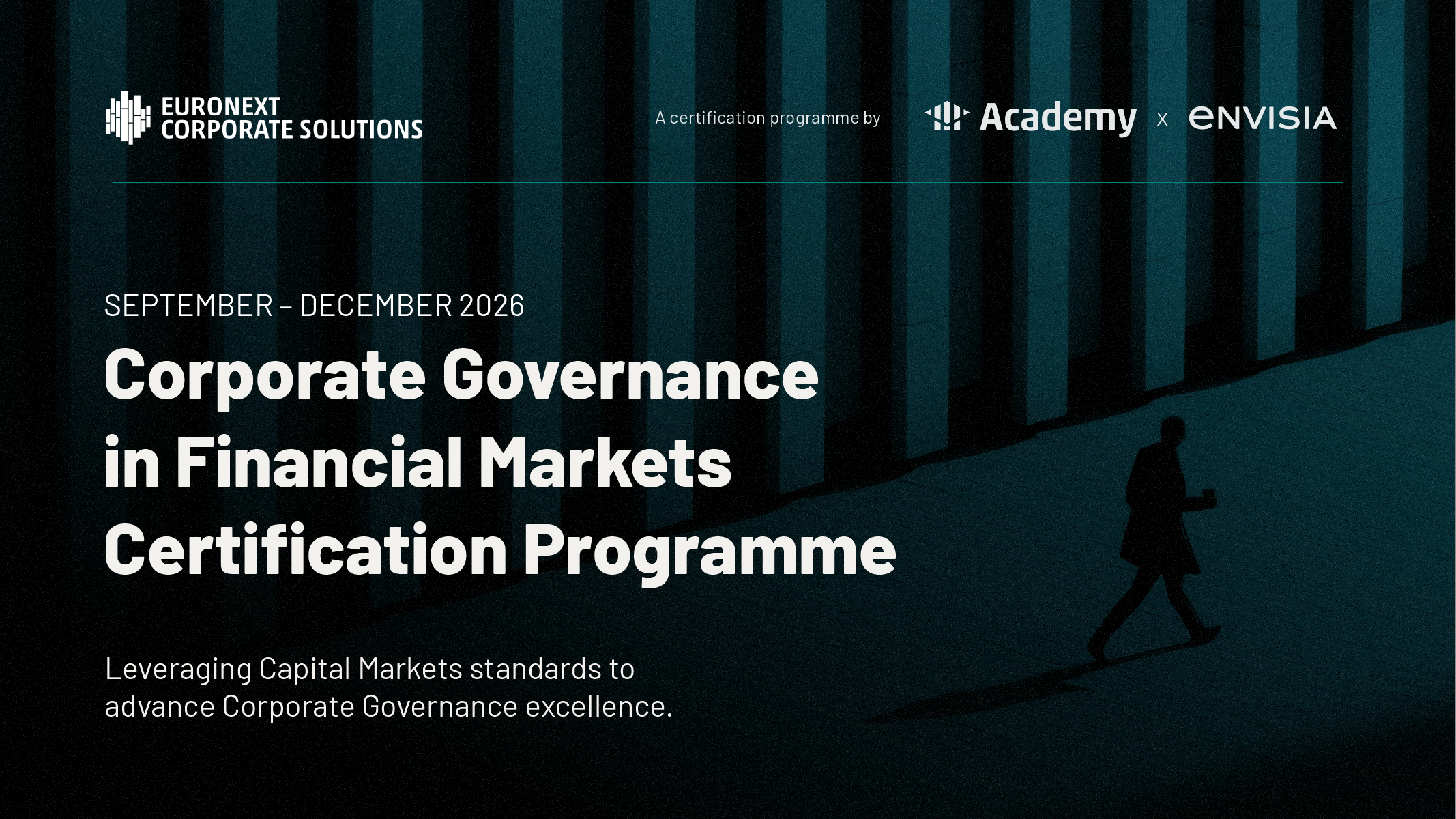
In an era defined by rapid technological shifts, volatile investor sentiment, and unprecedented regulatory scrutiny, general board education is no longer enough. While foundational corporate governance establishes the core principles of responsible leadership, operating at the intersection of boardroom dynamics and complex financial ecosystems requires a specialized, bulletproof skill set.
Enter a historic European first in executive education: the CORPORATE GOVERNANCE IN FINANCIAL MARKETS (CGFM) CERTIFICATION PROGRAMME, developed through a strategic partnership between Academy - Euronext Group (the educational pillar of the leading pan-European market infrastructure) and Envisia - Boards of Elite (the first business school in CEE dedicated to boardroom professionalism).
This program represents a paradigm shift. It rejects the label of simple compliance certification, positioning governance as what it truly is: a critical infrastructure for market trust and systemic resilience.
“Anchored in the strategic partnership between Envisia and Academy – Euronext Group, 'Corporate Governance in Financial Markets' is a unique professional certification engineered for high-scrutiny, regulated environments. This specialized educational vertical goes far beyond traditional compliance, merging world-class financial market expertise with cutting-edge boardroom leadership." says Gabriela Hârțescu, Dean and Founding Member of Envisia - Boards of Elite.
The Paradigm Shift: From Foundational Governance to Specialized Financial Markets Expertise
The unique architecture of the CGFM program recognizes that governance in financial markets is a double-edged sword of scrutiny: the intense, data-driven prudential regulations of the banking sector (such as Basel III/IV) meet the public and unforgiving oversight of capital markets. The program is built to navigate both seamlessly.
The CGFM program takes these ultra-rigorous standards and translates them into actionable boardroom strategies for the entire financial services ecosystem. It provides an elite roadmap tailored for:
- Listed and public companies navigating intense disclosure timelines.
- Regulated financial entities (Banks, Asset Management companies, Private Equity, and Insurance firms) looking to scale strategic oversight.
- Scale-ups and family-owned businesses preparing to tap into capital markets for future financing.
Navigating the New Era of Regulatory Scrutiny: DORA, AI Act, and CSRD
Modern board members and top professionals in financial services no longer have the luxury of treating macro-prudential oversight, systemic risk, or digital disruption as peripheral, technical topics. The CGFM curriculum addresses cross-border regulations and evolving high-scrutiny frameworks head-on, delivering deep-dive insights into:
- The Modern Regulatory Landscape: Mastering the permanent, practical implications of complex frameworks—such as DORA, the AI Act, CSRD/CSDDD, and Basel III/IV—at both the operational leadership and boardroom levels.
- Stewardship vs. Compliance: Moving beyond check-the-box exercises to align organizational strategy and oversight with dynamic investor relations calendars, activist shareholder engagement, and long-term market integrity.
- Digital & Cyber Governance: Equipping leaders and directors with the continuous skills needed to actively manage and oversee fintech integration, digital transformation risks, and systemic cybersecurity exposure.
An Elite Roadmap for the Entire Financial Services Ecosystem
What sets this program apart on the international stage is its rigorous quality framework and commitment to continuous professional development.
Upon passing the final assessment—a real-world Corporate Governance Diagnostic presented in front of an international Evaluation Commission in Amsterdam—delegates are awarded a unique international credential.
Reflecting a true commitment to lifelong learning, the validity of the Corporate Governance in Financial Markets Certificate is maintained through 20 CPD (Continuing Professional Development) hours accumulated biennially (every two years). This ensures your expertise remains permanently synchronized with the evolving pan-European financial landscape.
Program Logistics at a Glance (Autumn 2026 Cohort)
- Structure: 145 total hours (50 contact hours, 95 individual study hours) delivered in a premier blended/hybrid format.
- The Learning Journey:
- Phase 1: In-Person Kick-off: Initial immersion modules hosted at the Euronext Offices in Milan (24-25 September).
- Phase 2: Virtual Specialization: Six intensive online modules (Modules 3 to 8) delivered in a virtual classroom format, allowing for deep-dive learning while maintaining professional flexibility.
- Phase 3: Final In-Person Capstone: The Capstone Experience, Boardroom Simulation, and Certification Ceremony hosted at the Euronext Offices in Amsterdam (9-10 December).
- Key Dates: Application Deadline: 15 September 2026 | Program Start: 24 September 2026.
- Investment: €5,400 + VAT (An Early Bird 10% discount is applicable until 15 July 2026).
Don't just adapt to market pressure—lead the transformation. Join a high-caliber network of peers spanning two distinguished alumni communities (Euronext Academy and Envisia).
"For top-tier professionals navigating today's complex economic landscape, mastering pan-European regulatory fluency is no longer optional—it is a strategic necessity. By embedding the stringent transparency of regulated environments into actionable boardroom leadership, this program builds true institutional resilience. It equips executives to balance complex stakeholder dynamics with systemic stability, reinforcing public and institutional trust in the financial markets.”, emphasizes Gabriela Hârțescu.
👉 [Download the Official CGFM Brochure and Secure Your Seat Today]
FAQs
1. What is the CGFM corporate governance certification?
The CGFM corporate governance certification is a specialized credential designed for professionals who want to strengthen their governance expertise in financial markets. It focuses on the realities of regulated financial institutions, including risk oversight, digital resilience, sustainability governance, capital requirements, and board-level accountability.
2. Who should consider a governance certificate focused on financial markets?
A financial markets governance certificate is suitable for board members, senior executives, risk leaders, compliance professionals, legal advisors, investors, and professionals preparing for board roles in banks, insurance companies, asset managers, private equity firms, fintechs, and scale-ups operating in regulated environments.
3. How is CGFM different from a general corporate governance certification?
A general corporate governance certification usually covers broad principles such as board roles, ethics, shareholder rights, and oversight duties. CGFM goes further by focusing on financial services governance, where boards must understand complex regulation, systemic risk, digital operations, sustainability reporting, and market-specific accountability.
4. Does CGFM help with board readiness?
Yes. CGFM functions as a board readiness program for professionals who want to operate confidently in financial services boardrooms. It helps participants understand how to challenge management, assess strategic risks, oversee regulatory obligations, and contribute to governance decisions in highly supervised markets.
5. Why are DORA, the AI Act, CSRD, and Basel III relevant for board members?
These frameworks affect how financial institutions manage technology, cyber resilience, artificial intelligence, sustainability reporting, due diligence, capital adequacy, and risk governance. Board members are increasingly expected to understand their strategic implications, not only delegate them to compliance or technical teams.
6. Is CGFM an IT governance certification?
CGFM is not a traditional IT governance certification, but it includes important digital governance topics relevant to financial institutions. It addresses board-level oversight of technology risk, operational resilience, cybersecurity, data governance, artificial intelligence, and regulatory expectations such as DORA and the AI Act.
7. Why does financial services governance require specialized training?
Financial services governance requires specialized training because financial institutions operate under higher regulatory scrutiny, stronger risk controls, and broader stakeholder expectations. Directors and senior leaders must understand prudential regulation, conduct risk, capital requirements, resilience, sustainability, and fiduciary duties in a sector where governance failures can have systemic consequences.
8. What makes a corporate governance certification valuable for board careers?
A valuable corporate governance certification should combine practical boardroom relevance, regulatory awareness, international recognition, expert faculty, assessment standards, and ongoing learning requirements. For financial services professionals, the strongest programs also connect governance theory with sector-specific risks and supervisory expectations.
9. Why are CPD hours important for maintaining a governance credential?
CPD hours help ensure that certified professionals continue updating their knowledge as regulations, market practices, and board responsibilities evolve. In financial services, ongoing learning is especially important because frameworks such as DORA, the AI Act, CSRD, CSDDD, and Basel standards continue to reshape governance expectations.
10. Is CGFM relevant only for current board members?
No. CGFM is also relevant for executives, advisors, entrepreneurs, investors, and high-potential professionals preparing for future board mandates. It is particularly useful for those who want to build credibility in financial services governance before taking on formal non-executive or supervisory responsibilities.
 Facebook
 Linkedin
Recommended articles
ESG & Risk Oversight
Governance & Board Effectiveness
Governance & Board Effectiveness
Governance & Board Effectiveness
Governance & Board Effectiveness
Digital Transformation & AI Governance
Governance & Board Effectiveness
Governance & Board Effectiveness
Governance & Board Effectiveness
Governance & Board Effectiveness
Digital Transformation & AI Governance
Digital Transformation & AI Governance
Governance & Board Effectiveness
Leadership, Boardroom Dynamics & Crisis Response
Future of Boards & NED Careers
Leadership, Boardroom Dynamics & Crisis Response
Governance & Board Effectiveness
Leadership, Boardroom Dynamics & Crisis Response
Digital Transformation & AI Governance
ESG & Risk Oversight
Governance & Board Effectiveness
Leadership, Boardroom Dynamics & Crisis Response
Digital Transformation & AI Governance
Leadership, Boardroom Dynamics & Crisis Response
Leadership, Boardroom Dynamics & Crisis Response
Governance & Board Effectiveness
Future of Boards & NED Careers
Future of Boards & NED Careers
ESG & Risk Oversight
Leadership, Boardroom Dynamics & Crisis Response
Governance & Board Effectiveness
Governance & Board Effectiveness
Leadership, Boardroom Dynamics & Crisis Response
Future of Boards & NED Careers
Governance & Board Effectiveness
Governance & Board Effectiveness
Governance & Board Effectiveness
Governance & Board Effectiveness
Future of Boards & NED Careers
Leadership, Boardroom Dynamics & Crisis Response
Future of Boards & NED Careers

