 BACK TO ARTICLES
Protecting Leaders in the Age of AI: Building an AI Governance Framework for the Board
.png)
There is a rise of leadership cases exposing the misuse of AI as fraudulent, distortive and misrepresentative, including deep fake videos, cloning, voice or appearance alterations, and editing of statements. Leaders have to navigate protecting their authentic reputation and trust in digital, algorithm driven and social media constructed environments.
Navigating the EU AI Act Summary and 2026 Compliance
The EU AI Act was established in 2024 and the Romanian AI Act is coming into force in 2026. Such regulatory developments call upon leaders owning AI awareness, literacy and transparency. The governance accountabilities between technology providers and organisational users highlights need for deeper understanding of the sources of information, contingencies for cyber security and AI risk governance are strategic leadership priorities. In UK, companies including JLR and Marks & Spencer faced major cyber-attacks. Meanwhile in Romania, Electra Group and National hospitals have had cyber-attacks.
More recently in 2026 Conpet was disrupted by a Cyber-attack. Meanwhile, AI is changing traditionally low-cost labour markets with AI investment and adoption. McKinsey estimate AI can add 30-40bn Euros to Romania’s economy. Banca Transylvania is applying AI to customer service and for new ways of working. Further, the pace of AI adoption between Romania and other European countries highlights an investment, skills and pace-of adoption gap.
Leaders are ultimately held accountable for their decisions, particularly those made under time pressure. Their actions are subject to extensive scrutiny, interpretation, and challenge by multiple stakeholders. Consequently, it is imperative for contemporary leaders to prioritise the development of their technological and AI literacy, ensuring they possess the knowledge and judgement required to maintain both personal credibility and organisational legitimacy. AI has emerging implications for Directors’ liability and insurance.
Beyond Technology: Why Responsible AI Leadership is a Board Priority
Artificial intelligence has evolved beyond being merely a technological tool that supports human work and decision-making. It is fundamentally reshaping how leaders interact with information, exercise judgement, and make discretionary decisions. AI's self-learning capabilities are increasingly surpassing human cognitive capacity in analysing vast quantities of real-time data, identifying patterns, predicting scenarios, and generating recommended courses of action.
As AI becomes embedded in leadership practice, it also creates new cognitive and emotional dependencies, challenging traditional assumptions about leadership. This raises fundamental questions: What does it mean to be a leader in an AI-enabled environment? How does a leader continue to create value when AI increasingly performs analytical and predictive functions? The answer lies not in competing with AI's computational capabilities, but in providing ethical oversight, contextual understanding, critical judgement, and accountability for decisions that ultimately affect people and organisations.
6 Resilience Practices to Protect Leaders from AI Risks
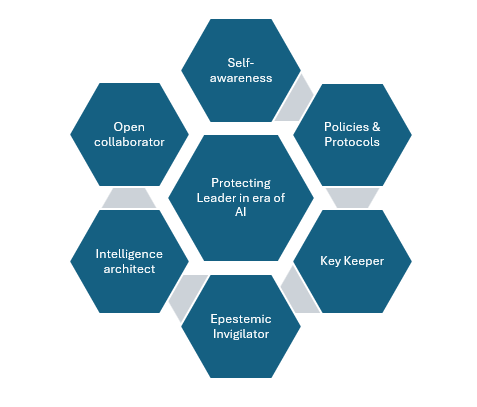
It is imperative for today’s leader to invest appropriate time and effort in finessing their ‘tech-intelligence’ as priority for ensuring personal and organisational legitimacy. This draws into focus 6 resilience practices for protecting a leader from AI risks:
1) Open Collaborator
Leader must be seen evolving their own personal awareness and understanding of Artificial intelligence. It is not just delegating to IT or Risk department. As leader, I need to be familiar with and comfortable discussing the implications and impacts of emerging AI. No question is stupid! Leaders need to promote shared conversations on AI within executive and board level decision-making. Burying your head in the sand or fear of the unknown is unacceptable. Whilst it is the leader’s decision, this should involve seeking out trusted colleagues opinions and views.
2) Intelligence architect
Leader must clearly position and communicate the acceptable behaviours and application of AI eco-system within organisation and across stakeholders. This is about investing proportionately and regularly to enhance governance and competitive AI design and its reach of data sensitive assets. Leader has to set the conditions and boundaries of their organisation. As leader monitors and evaluates teams, so should the AI footprint be on a radar.
3) Epistemic Invigilator
Leader must consider originating sources, quality and reliability of evidence. This includes how AI or technologies are involved in collating and presenting datasets. Leader needs to be able to interpret evidence, inclusive of its forming attributes, such as motive or agenda; causation, manipulation, error, representation, bias and intellectual ownership. Leader should intervene and corroborate multiple evidences in decision-making process to support executive and board consensus. In this respect, leader should intuitively question assumptions, challenge rationale and evaluate contextual settings.
4) Key Keeper
Leader must establish a custodian mindset whereby executive and board members actions are equitably accountable for preserving and guarding the material privacy, flow of information, level of access and ethical conduct for engaging AI. It is AI serving the leader values and not the other way around. Security is more effective when personal liability extends to a relationship of having shared accountabilities. Leaders have to respect each other and guide that which AI cannot – when is this harmful, that which is invisible, having the courage to say no. It is leader that decides how and when to use AI.
5) Policies and protocols
Leader must adhere and comply to industry and regulatory standards. AI policies need to align across multiple levels and extend to supplier, customer, third party and AI provider arrangement. AI risks represent a moving target, it is vital to review and keep up to date with AI developments. The dark-side of AI is becoming more sophisticated as we have seen with cyber-attacks. In this regard all members of the organization are leaders and must protect the organisation. The policies are a basis for building protocol – how will we respond to potential situations and what is the protocol and who are the key contacts, it should be leader overseeing AI governance.
6) Self-awareness
Leader must periodically provide time for self-reflection and self-awareness. Executive and Board members need to understand themselves and each other. Self-awareness facilitates personal strengths and limitations, biases, over-confidence, blind spots, power and politics, emotional attachments as opportunities to zoom out and zoom back in. In the case of AI, the balance between professional and personal life can become blurred. These days your mobile or internet, online profile are all to be refreshed and protected.
Conclusion: Tech-Intelligence as the New Leadership Currency
To protect leaders in an era of AI, building higher order human interventions as sounding board, moderator, challenger, supporter, tester and evaluator is important. Being a leader is often presented as a lonely role – in the case of AI, it calls for more collaborative and empathetic skills empowering board and executive stewardship.
(a published version in Board Agenda Jan 26: https://boardagenda.com/2026/02/03/6-steps-to-protect-leaders-in-the-era-of-ai/)
 Facebook
 Linkedin
Recommended articles
ESG & Risk Oversight
ESG & Risk Oversight
Governance & Board Effectiveness
Governance & Board Effectiveness
Governance & Board Effectiveness
Governance & Board Effectiveness
Digital Transformation & AI Governance
Governance & Board Effectiveness
Governance & Board Effectiveness
Governance & Board Effectiveness
Governance & Board Effectiveness
Digital Transformation & AI Governance
Digital Transformation & AI Governance
Governance & Board Effectiveness
Leadership, Boardroom Dynamics & Crisis Response
Future of Boards & NED Careers
Leadership, Boardroom Dynamics & Crisis Response
Governance & Board Effectiveness
Leadership, Boardroom Dynamics & Crisis Response
Digital Transformation & AI Governance
ESG & Risk Oversight
Governance & Board Effectiveness
Leadership, Boardroom Dynamics & Crisis Response
Digital Transformation & AI Governance
Leadership, Boardroom Dynamics & Crisis Response
Leadership, Boardroom Dynamics & Crisis Response
Governance & Board Effectiveness
Future of Boards & NED Careers
Future of Boards & NED Careers
ESG & Risk Oversight
Leadership, Boardroom Dynamics & Crisis Response
Governance & Board Effectiveness
Governance & Board Effectiveness
Leadership, Boardroom Dynamics & Crisis Response
Future of Boards & NED Careers
Governance & Board Effectiveness
Governance & Board Effectiveness
Governance & Board Effectiveness
Governance & Board Effectiveness
Future of Boards & NED Careers
Leadership, Boardroom Dynamics & Crisis Response
Future of Boards & NED Careers

